
NTPC to be the worst hit, stock slides to five-year low on announcement.
Experts say it will now be tough for the Modi government to catch up with the UPA's economic record owing to the shock induced by the currency demonetisation.

Total income of Wipro was almost flat at Rs 15,571.4 crore at the end of the first quarter of 2020-21 compared to Rs 15,566.6 crore in the corresponding quarter of the fiscal year 2019-20.

As inflation rate is near the upper limit of the comfort zone, experts rule out rate cuts anytime soon

The benchmark Sensex companies' underlying earnings per share are down 3 per cent (on a cumulative basis) since January 2015, against 25 per cent rise in the index value during the period

12 out of 21 public sector banks reported declines in their loan books in the last financial year against seven such banks in 2015-16 and none in 2013-14.

About 55 per cent of the public offers that hit the market since 2008 are still trading below their issue price.

During the month, inflation in vegetables shot up to 35.99 per cent, as against 26.10 per cent in October. Likewise, the prices of cereals and eggs grew at a faster pace of 3.71 per cent.

The Sensex and the Nifty witnessed biggest one day loss in percentage terms since June 24

Recovery seen in Q4, companies continue to focus on enhancing cash flow

More than half the Sensex companies have declared their results for the third quarter and there are more positive surprises than disappointments.

Finance Minister Arun Jaitley said Sebi would develop new products in the commodity derivatives space apart from taking steps to deepen the corporate bond market.

Mid- and small-cap companies seem to have done better than top-tier companies

The combined share of customs and excise duties, service tax, and value-added tax in India's gross domestic product reached an all-time high of 10.5%.

In the domestic market, the Tata Group has lost ground in the passenger car business.

These firms reported a combined operating profit of Rs 26,077 crore (Rs 260.77 billion).

HUL, ITC, Nestle, Colgate, Dabur, Britannia, Asian Paints, P&G are trading at nearly 48 times. The previous record high was 53 times at the end of March 1994.

This is largely on the back of Tata Steel's expansion at Kalinganagar, as well as JLR's in China and Brazil

Rising oil prices and diminishing cash pile to limit capacity in 2018-19

Analysts say there is still no visibility of earnings improvement.

The number of infrastructure projects cleared by a monitoring group set up in the Cabinet Secretariat had increased consistently in the past year.

According to Rahul Rege, business head (retail) at Emkay Global Financial Services, it is difficult to track more than 10 stocks.

'It was because of the huge selloff in the Indian equities that the rupee fell so sharply against the dollar on Friday.'

There, however, has been an improvement in operating margins.

The buyback price is at around 28 per cent premium to the current market price of Rs 67 on the Bombay Stock Exchange

Investors turn their attention to export-driven sectors.
With mutual funds, promoters turning net-buyers, foreign investors may have to bid up prices to raise holdings.

With commodity markets remaining soft and uncertain, it is likely the money will flow into equity markets with strong upsides, such as India.
IT sector's trading multiples hit post-Lehman lows, providing good entry points.

For equity investors, the risk-to-reward ratio is worsening.
Axis Bank's acquisition of Citibank's consumer finance business for Rs 12,325 crore - the second biggest deal in the Indian banking sector - is seen as a good deal at a good price. The acquisition enables Axis Bank to close the gap with competition in some key segments such as credit cards. At the same time, there are some key issues that are crucial for the deal's success, apart from the fact that it will take some time for Axis to reap the full harvest of its investment.

The road ahead for the markets in the short term will depend on external factors rather than domestic developments.

The internals of the food inflation are worrying, given a broad-based uptick across categories that tend to be sticky, such as proteins, and a narrower-than-expected reduction in inflation for vegetables.

Sales expansion also down 4.4%

Analysts refuse to read too much into the early birds numbers.

'The government is encouraging consumption through fiscal spending in a bid to push up economic growth in the face of a slowdown in corporate investment and exports.'
Indian companies typically have higher return on equity.

Analysts mostly prefer domestic plays beside select films with foreign exposure.

HUL, UltraTech, Asian Paints, L&T, HDFC Bank top global valuation charts
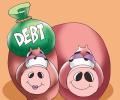
Corporate India at present is more indebted than all state govts put together.
 © 2026 Rediff.com - Advertise with us - Disclaimer - Privacy Policy - Sitemap - Feedback - About us - Terms of use - Grievances